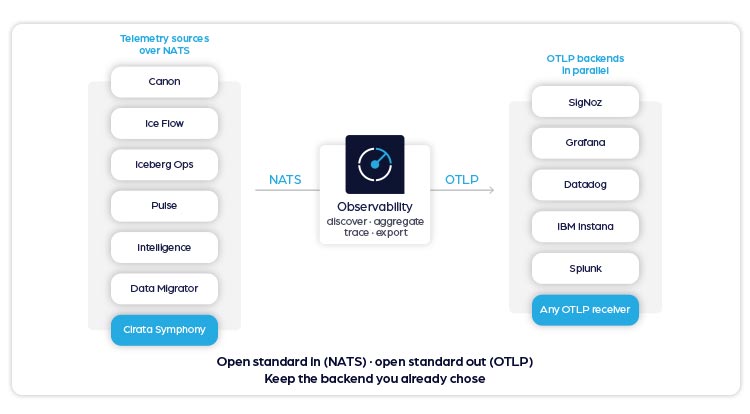
See your entire Cirata Symphony estate as one OpenTelemetry stream, every extension, every signal, into any backend you already run.
Observability is built on OpenTelemetry, the consensus protocol every major backend now ingests natively. It collects telemetry over Cirata Symphony's messaging fabric and emits it as plain OTLP, so your telemetry tier is portable rather than disposable. Switch backends without re-instrumenting a single extension.
Collects from:
Canon · Ice Flow · Iceberg Ops · Pulse · Intelligence · the Symphony platform itself · any extension that adopts the observability SDK
Forwards to:
SigNoz · Grafana / Tempo · Datadog · Splunk · IBM Instana · any OTLP receiver — one backend or several in parallel
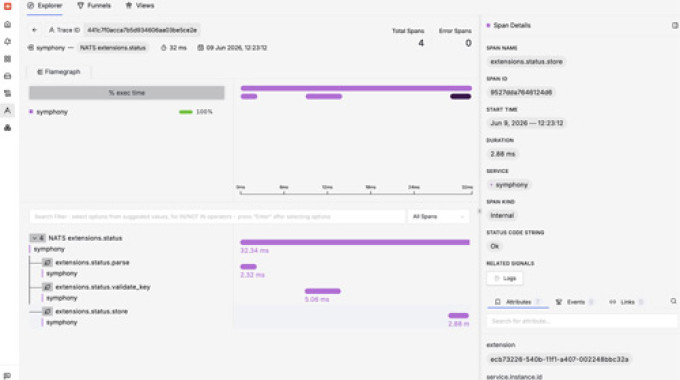
When an incident crosses Canon, Ice Flow, and Pulse, get one distributed trace covering every messaging hop, instead of a post-mortem that stalls on "which extension was involved, and in what order?
Run SigNoz for engineering, Datadog for the SRE team, and Instana for the IBM side, all from a single aggregation pass. Switching primary backend is a config change, not a re-instrumentation project.
Answer the auditor's question, can you reconstruct the request path behind a customer-visible failure, and can you prove it? With cross-component traces and a verifiable audit trail of every collector change. Built for DORA, Basel III, NYDFS, and APRA CPS 230.
Roll out a new extension and its telemetry flows the next aggregation cycle. No collector config update, no restart, no operator ticket. Cirata Symphony's extension lifecycle is the telemetry-source lifecycle.
Observability lists messaging services and matches the standard telemetry subject pattern. Every extension that registers it is found automatically.
Each signal, metrics, logs, traces, is pulled on its own schedule, merged, and split into export-sized batches. Trace context rides every messaging call, so spans chain into one tree.
Each configured collector gets its own OTLP client. One aggregation pass fans out to every backend you've enabled, with TLS, headers, and per-signal toggles per destination.